102mm SSP Brew v2 Burrs: First Impressions and Musings
I was not planning on making this post so soon, but, to my surprise, my initial impressions of this burrset were so strong that I immediately feel compelled to sit down and jot down my notes.
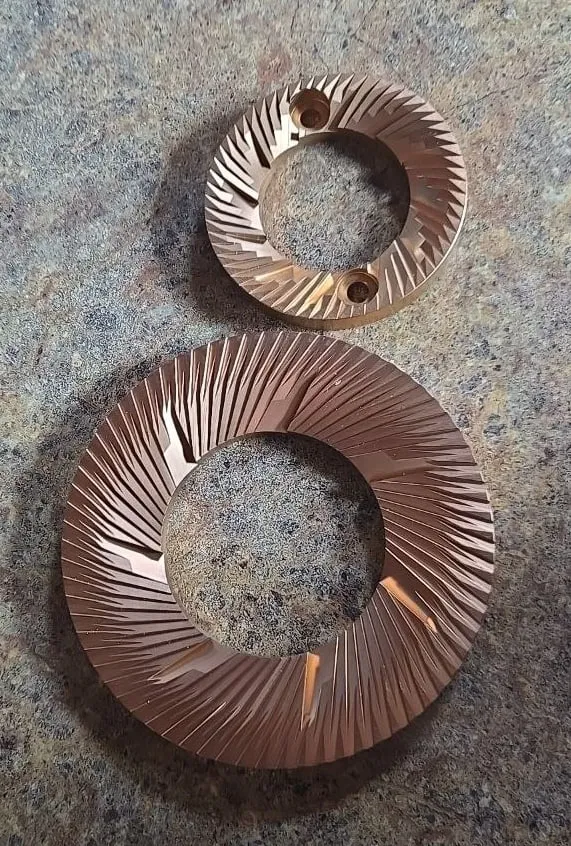
Red Speed SSP Brew v2 burr next to 65mm HU burr
I received these burrs via Fedex yesterday afternoon, after ordering them just six days before. Apparently, Hansung from SSP uses overnight shipping for his products, which is a nice perk for a customer ordering expensive equipment. In the evening, I began the process of seasoning the new burrs, from bags of stale coffee leftover from the cafe (accumulated over several years due to stocking errors), I managed to procure and an estimated 40 lbs. (18 kg.) of coffee. I have heard testimony that these burrs, with the Red Speed coating that I purchased, can require closer to 100 lbs. to be fully seasoned; not having access to this volume of coffee (or the desire to spend capital on it), I opted to start with 40 lbs. and let the burrs improve naturally.1
As it was very late by the time I had the grinder cleaned and put back together, I did not manage to brew coffee with these burrs until this morning.
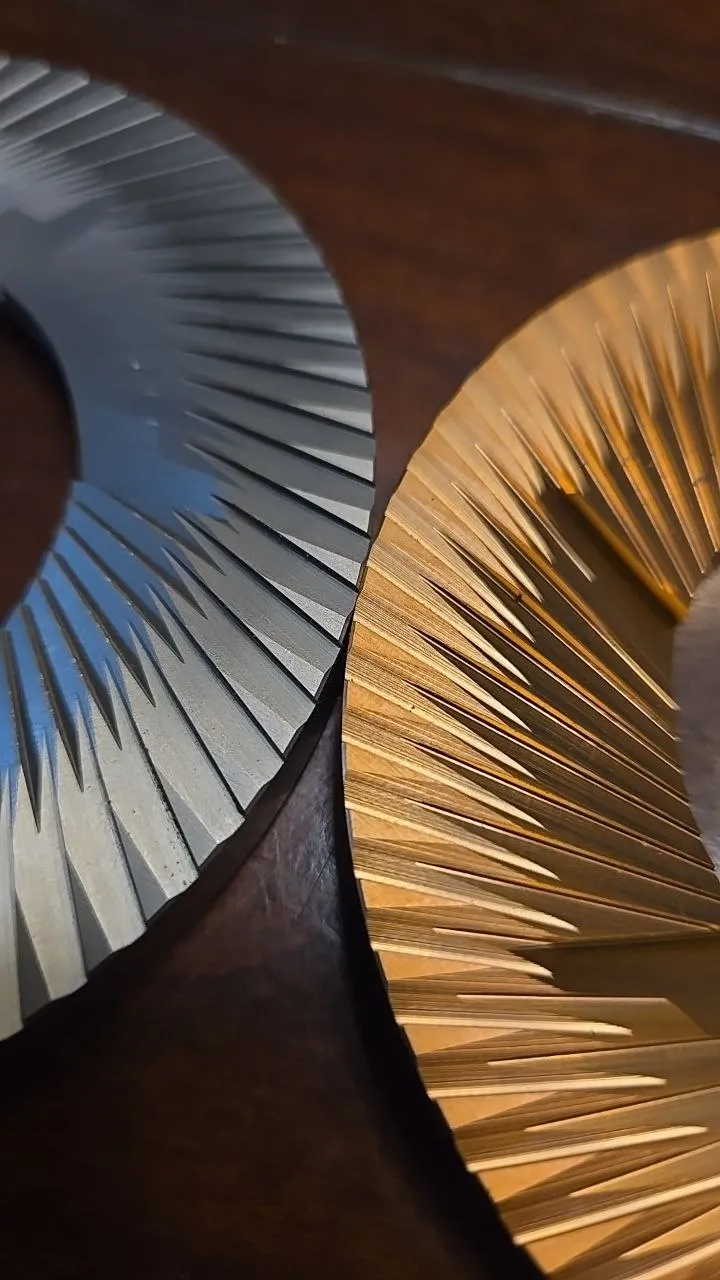
Silver Knight-coated 102mm Brew burrs, right; Red Speed-coated 102mm Brew burrs, left. Note the geometric difference between the two burrs; to my eyes, the main difference appears to be around the middle of the grind path with the extended teeth on the v2s.
My Lagom 01 (with PCS) was purchased for Uncloud Coffee at the end of its existence, and is one of the few assets I chose to keep after shutting the business down. I purchased it new from Option-O with their 102mm Mizen burrs installed (find my opinions on those here), and purchased a used set of 102mm SSP Brew Burrs in Silver Knight coating from an enthusiast on Home Barista, with the intention of experimenting and possibly implementing them commercially later. Within a month of that purchase, SSP released their revised 102mm Brew burrset, thus designating my set as "v1" and the newly released set as "v2".
Earlier this year, as I was uninterested in the Mizens' profile for personal use, I installed the v1 Brew burrs, which were well-seasoned, and have mainly elected to use them for my pourovers over the past couple months.
My results with them have been mixed. While I have found myself enjoying their profile greatly in a handful of "perfect" brews, my main impression of them has been their capacity to make intense, favorably aromatic brews that are often marred by astringency and "brownness" in the finish. Other than the "high cups", I found that these highly aromatic/astringent brews were achievable about half the time, where as in the other half of brews, the finish was similar but the aromatics and acidity were muted. In this way, they reminded me of the 64mm SSP Multipurpose burrs (mentioned here); they have the capacity to make intense, highly aromatic brews, at the cost of a high threshold for "punishing" flaws in the other variables of brews. It's worth mentioning that my struggles with this burr absolutely could have been a result of my own "skill issues", but I just never felt that I could really find a consistent sweet spot with these burrs. In addition, these burrs are plagued by retention issues (with some users suffering from them far worse than I did), and many users often maligned their geometry as being of less quality than the beloved 98mm Brew burrs.
Excursus: Lots of effort is made by prominent, integrity-driven voices in the coffee industry to de-emphasize the necessity of high-end equipment in the process of making tasty coffee at home, and for a plethora of good reasons. Not least of these are the often-dubious claims of manufacturers' marketing departments, influencers with various motivations for praising the equipment they present, and forum contributors with a compulsion to justify their purchases by virtue strictly of how much they paid for them2. Trustworthy accounts of the effects of equipment can be hard to come by, especially if you live in an area without a broader coffee community around you. Especially when we consider the grinder: it is simply one link in the chain of variables that makes a cup of coffee tasty or not, and one somewhat further down the chain at that (!water).3
Yet sometimes I think this often boils down the entire concept of expensive grinders to an idea that these pieces of equipment are strictly for those with money to burn and who want to bump up the quality of their coffee from 99% to 100%, and that most people can make due with the 99% quality and only be 1% poorer for it. Does this idea carry truth? Absolutely, but as with most contentions, the reality is more complex.
To illustrate this, I will describe my first three brews with the 102mm v2 Brew burrs today.
For all three, the coffee was this washed Chirioso from William Ortiz in Colombia, roasted by SEY Coffee. I used [Chris Shotwell's Holy Water mod] recipe with some additional silicon drops as brew water, as I've found an undesirable variability in my individual mineral droppers that I need to address before I can reliably use them; I chose it as a reliable base water for my brews to test these burrs today, and I tend to enjoy this modification over the original Holy Water recipe. Each dose was 15 grams of coffee to about 250g of water, so under a 1:17 ratio.
The first dose was a bit finer than the others (I didn't write it down, but I'd estimate around 510 microns from chirp) at RPM setting 8, and brewed on a V60 with a T-90 paper. I used a double bloom, as the coffee was a bit fresh (about 2.5-3 weeks off roast), and did a single pour all the way up to my final water amount after the bloom. The resulting cup was smooth and bright, not high in sweetness but sweet enough, and seemed to have subtle, alternating layers of watermelon and peach aromatics. The taste was lovely, and the only flaw I found in the brew was in the finish, where there was just a slight unpleasant flavor that vanished as soon as you noticed it; so quickly, in fact, that it was difficult to actually discern why it was unpleasant. For a first cup with a brand new burrset, I was shocked to taste such a nice cup, with lovely (albeit slightly underwhelming) aromatics and no astringency or harshness.
The second brew was another V60, ground coarser at about 760 microns from chirp (this number is more reliably memorable for me) and at the same RPM. For this brew, simply playing around with presentations by recipes, I adopted a recipe very close to Brian Quan's high agitation V60 recipe, and this time forgoing the double bloom due in preparation for high agitation in the form of "yeet pours." This cup was also surprisingly memorable; smooth, no astringency, and with a light body. However, this was slightly less aromatic, I believe due to the lack of double bloom. There was also a familiar sharpness: freshness. Coffees that brew too fresh tend to carry a certain sharpness, I find, that isn't strictly unpleasant, but isn't really desirable. This brew also represented a very high positive for me, in that there was nothing to truly complain about in this cup aside from the freshness of the coffee beans themself. It was a good brew, limited only by the beans.
The third was inspired by the specific parameters outlined by Insider in his review of his 102mm Brews: a 750 micron from chirp burr gap, RPM setting 9, in an Orea Z1. This was just out of curiosity to whether or not these numbers would translate. I used Brian Quan's 15g Z1 recipe, which I have found to be largely reliable and don't feel the need to deviate much from.4 The result was a cup very similar in features to the second V60 brew, but with a different presentation. As opposed to the previous brew, which was more up-front, freshness seemed to present with more sharpness and over the entirety of the palate, perhaps because the low-agitation no-bypass approach tends to present more clarity, in my opinion. But again, there was little-to-no astringency like I might have expected from my experiences with similar parameters using the V1 brews.
What is there to conclude from this? Very little, due to the limited experience that three samples in one day can actually offer, but I feel optimistic. I am impressed beyond my hopes at the quality of these three brews, given that I didn't do any additional dialing for any of them. I feel as though I am at the threshold of my motivation for owning a high-end grinder like the Lagom 01 and investing the $600 I spent on these v2 Brew Burrs, which is something that I haven't truly found in any of these grinders or burrs I've used at lower price points, and even among those at similar ones. I recall hearing the owner of a high-end grinder manufacturer say once, I remember not where: "Our goal is to eliminate the grinder as a variable; if there's something wrong in the cup, it won't be the grinder." And this, I believe, is the motivation to invest in this type of equipment for somebody who treats specialty coffee as more than just a hobby or a "daily cup." I've stated before on this site that my intention is to learn and train in the art of brewing coffee, and I have [potentially] gained in these burrs is something invaluable to this pursuit: a confidence in my equipment that can behave as a baseline. Up until this point, my $2800 Lagom 01 has not been behaving like this for me; the Mizens were good but unimpressive, and from the v1 Brew burrs I found it possible difficult to extract a good tasting cup. If my v2 Brew burrs continue to behave in the same way, the 01 will finally be living up to the potential I desire from it, and give me the reliability I seek to eliminate the grinder from the list of potential flaws in a brew.
This is absolutely a premature take, as I am very aware. But this is my first impression, and I feel that the burrs are on track to make themselves worth the money I paid; not so much for the so-called "diminishing return", but for a simple peace-of-mind associated with reliable equipment. This is what makes high-end equipment valuable for the few people who are passionate and devoted enough to this discipline to invest in it.
If this keeps up, I don't see myself needing to spend inordinate amounts of money on equipment in the near future, or feel compelled to upgrade from the current set-up. I do have plans to soon be a part of a sort of grinder project experiment, but nothing that I feel like I "need" to acquire in order to continue my journey. At some point I would like to acquire a solid 80mm grinder, to provide myself with variety and a chance to explore that platform; but it doesn't feel like this is necessary. The grinder and burrs I have now will suffice to provide a faithful expression worthy of the beautiful coffees I intend to feed it.
In truth, it was my fear that these burrs would not live up to expectations I would have for such an expensive piece of equipment. Before my purchase, I obsessively read burr reviews, considered selling the 01 for a different grinder (which would be perhaps much more expensive, requiring even much more capital than a sale could yield me), and meticulously considered every possible option in order to make the wisest possible use of the resources I have. Even when I began brewing this morning, I felt my doubts creeping in that I would be in for a painful waste of coffee in order to "understand" and properly utilize these new burrs. (I am more confident in my brewing abilities than I used to be, but the weight of the purchase recalled my first experiences with burrs that carry high expectations: 64mm MPs). It is the surprise that this does not feel like the case that prompted me to share these thoughts.
As always, I'm grateful for all things. I know I will have more things to say about these burrs in the future, in more detail and across different coffees, waters, brew methods, etc.
I also attempted alignment, but ran into problems. These Brew burrs, like the V1, require circle shims placed underneath them in their respective top and bottom carriers for the burr outfalls to clear the rims of the carrier. When I conducted a dry-erase marker test for burr alignment, I found that the bottom burr required no additional shimming and that the top burr was slightly uneven. However, when I attempted to add shims underneath the top burr's circle shim, I found that the shim slid around too easily between the shim and the coating of the burr carrier. This may be something I attempt again in the future, but I decided to leave it for a future day, but with a chirp-to-lock distance of only 30 microns, my concerns about alignment are minimal.↩
Am I one of these? Perhaps, but I am normally pretty comfortable with admitting that something hasn't lived up to my expectations; plus, I found the initial brews with this burrset completely surprising. But hang on, I'm getting to that part.↩
Not to mention the high degree of subjectivity with regards to grinding burrs; it is never as simple as "more expensive is better." Some grinders and burrs better suit certain individuals with specific cup profiles in mind, or different coffees, or different brewing methods, etc. This is why the level of detail provided in Robert Asami's Burrtopia is so important; as Robert himself says: "There is no consensus."↩
While I have no conclusions to make about this, I observed that after the second pour, the water seemed to drain visibly slower through the bed than when I used the same recipe/burr gap/RPM with the V1 Brew burrs (or at least as I recall).↩